The Hidden Frictions That Kill Your Direct Bookings (and How to Fix Them)
Introduction
Here’s the uncomfortable truth: most hotels and STRs lose direct bookings long before a guest ever sees a rate or a room photo. In fact, despite years of industry talk about “cutting OTA dependence,” the share of direct online revenue across hotels sits at just 29.5% - while OTAs control nearly 49% of all online revenue. (D-EDGE, 2024)
So even as properties invest in better websites, paid ads, retargeting, and glossy branding, the maths doesn’t lie: guests still choose OTAs first. Not because they prefer them… but because your digital experience has frictions you cannot see and that your guest has no patience for.
Today, we expose those frictions. And fix them.
1. Your Website Is a Silent Conversion Killer
Before anyone compares rates, checks availability, or scans your reviews, your website has about three seconds to convince them they’re in the right place. If those seconds fail, the guest doesn’t complain - they simply go back to Google.
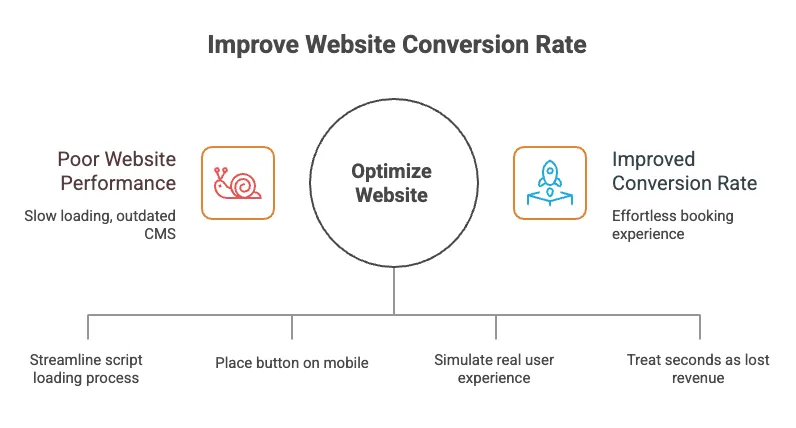
The D-EDGE report reveals a telling pattern: properties that struggle with website performance (slow load speeds, outdated CMS, poorly integrated booking engines) often lean heavily on OTAs without realising their website is the root cause. Direct channels underperform when tech foundations are weak - not when demand is weak.
Hotels often obsess over aesthetic design but overlook functional design. A beautiful homepage still kills conversion if:
-
the hero image is 8MB and loads like dial-up
-
the “Book Now” button is buried under sliders and pop-ups
-
the booking engine iframe loads after the guest loses interest
Guests aren’t abandoning you - they’re defecting to whichever site feels effortless. And OTAs feel effortless because their UX budgets are the size of your annual revenue.
Fix the silent killers:
-
Compress media and streamline script loading.
-
Place the “Book Now” button where thumbs naturally land on mobile.
-
Test your homepage on a budget smartphone - not your office Mac.
-
Treat every second of load time as lost revenue.
2. Your Messaging Doesn’t Persuade… It Merely Confirms
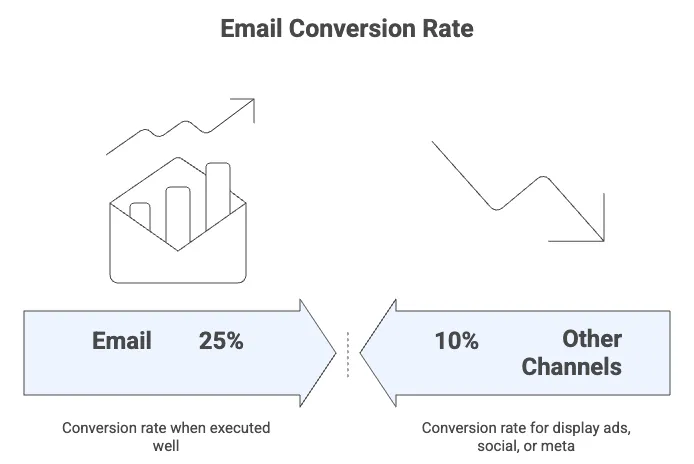
A surprising insight from the D-EDGE data: email remains the strongest performing direct channel, converting better than display ads, social, or meta when executed well. Yet most hotels treat emails as transactional notices, not as revenue tools.
Guests receive bland booking confirmations, sterile pre-arrival messages, and upsells phrased like fines instead of invitations. STR operators often rely on templated messages copied from Airbnb - which read exactly like templated messages copied from Airbnb.
Every touchpoint that isn’t personalised is a touchpoint that fails to differentiate you from OTAs.
Shift your messaging from administrative to persuasive:
-
Use the pre-arrival email to showcase value: “Here’s what past guests say made their stay special.”
-
Use segmentation: families, couples, business travellers, long-stays, locals.
-
Automate intelligently: timing matters more than volume.
When email engagement rises, direct bookings rise. D-EDGE’s data shows that hotels with coordinated CRM and email automation see a significantly stronger direct channel mix than those relying on web traffic alone.
Friction isn’t always technical - sometimes it’s simply tone-deaf communication.
3. Your Pricing Strategy Works for OTAs - Not for You
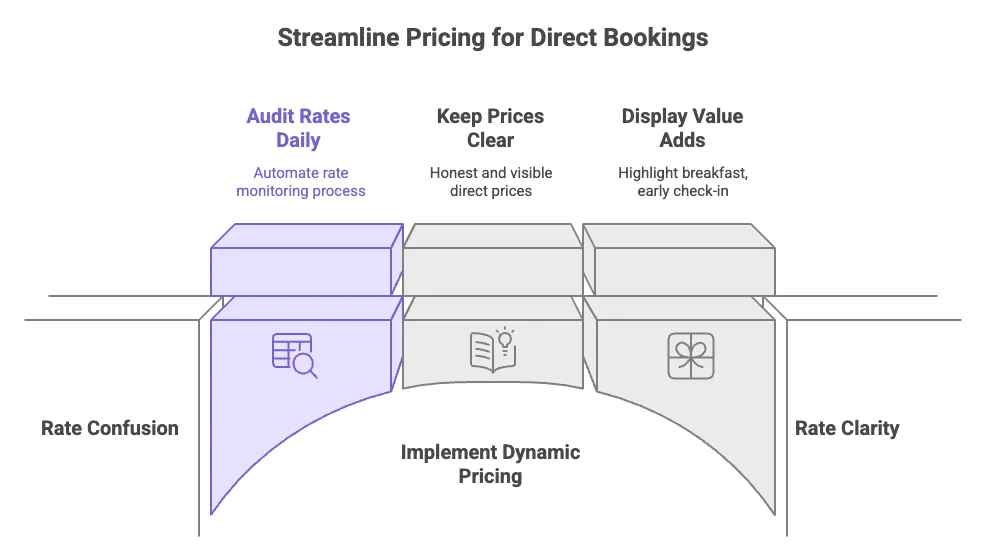
The modern traveller is a comparison shopper. They check multiple channels, multiple times, across multiple days. D-EDGE’s analysis shows that OTAs dominate because they specialise in rate clarity, while many hotels accidentally create rate confusion.
Guests see a rate on Google, a different one on the website, another on Booking.com, and a promo code that… doesn’t work. Confusion is friction. Friction kills conversion.
Rate parity isn’t only a contractual obligation - it’s a trust mechanism. The report confirms that hotels with inconsistent pricing see weaker direct performance, even when the website offers a lower rate. The guest assumes something is off.
Meanwhile, dynamic pricing systems used properly correlate with stronger direct share because:
-
rates remain consistent across channels
-
availability syncs
-
best-rate guarantees are actually believable
Fix the pricing friction:
-
Audit rates daily (or automate it).
-
Keep direct prices clear, honest, and visible.
-
Display value adds - breakfast, early check-in - not just a number.
A guest will book direct only when the price feels clear, fair, and final.
4. You’re Ignoring the Digital High Street: Metasearch
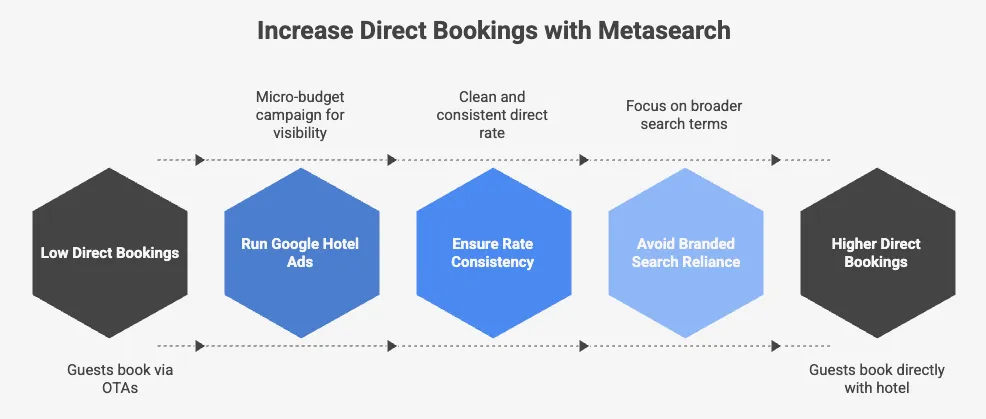
Metasearch - especially Google Hotel Ads - has become the modern “high street” of travel shopping. Guests start there because it’s fast, transparent, and instantly comparable.
Yet the D-EDGE report highlights a stark reality: smaller hotels dramatically under-utilise metasearch, despite it being one of the lowest-cost, highest-control acquisition channels available.
Hotels that do invest in metasearch enjoy significantly higher direct-share performance, because they appear exactly where guests are already searching. OTAs know this - that’s why they bid aggressively under your name.
If you’re absent from metasearch, the guest sees OTA rates first. And books first.
Fix visibility friction:
-
Run even a micro-budget Google Hotel Ads campaign.
-
Ensure your direct rate displays cleanly and consistently.
-
Avoid over-reliance on branded search: you’re already paying for your own traffic.
Direct bookings cannot grow if you aren’t present where the buying journey begins.
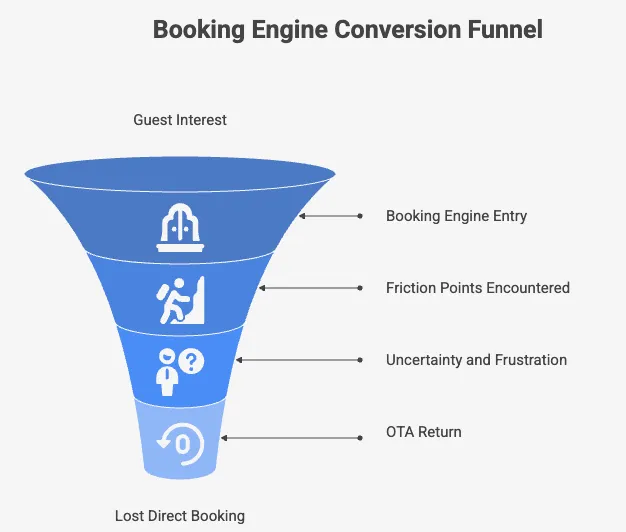
5. Your Booking Engine Is a Maze - Not a Funnel
After all the effort - SEO, ads, design, pricing - the booking engine is where revenue either materialises or evaporates.
According to the D-EDGE findings, many booking engines underperform because hotels haven’t configured them properly, don’t test them regularly, or cling to old systems that feel like relics from 2012.
Common frictions include:
-
too many steps before confirmation
-
unclear cancellation terms
-
broken promo codes
-
no mobile-first layout
-
hidden fees revealed only at checkout
Each friction point compounds. Guests who were willing to book suddenly feel uncertainty and uncertainty pushes them straight back to OTAs, where the process is smooth, predictable, and familiar.
Fix booking-flow friction:
-
Reduce steps to the bare minimum.
-
Make total price and policies obvious upfront.
-
Check mobile performance weekly - not annually.
-
Perform “mystery shopper” tests internally.
-
Ensure the engine retains details when guests navigate back a step.
If the booking engine strains the guest’s patience, they will reward your competitors.
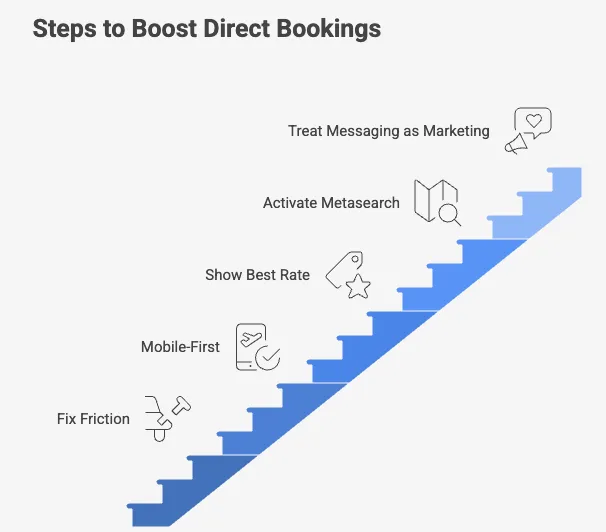
So What? Five Practical Moves to Lift Direct Bookings
-
Fix a friction every week. Page speed, messaging, pricing, booking flow. Direct bookings rise when obstacles fall.
-
Be ruthlessly mobile-first. Your guest books on the sofa, not a desktop.
-
Show your best rate clearly. Don’t make guests hunt for value - they won’t.
-
Activate metasearch. If you’re not visible there, you’re invisible everywhere.
-
Treat messaging as marketing. Every email should reassure, persuade, or delight - never just inform.
Conclusion
Your direct bookings aren’t falling because guests prefer OTAs. They’re falling because OTAs have removed every possible friction and your digital experience still has a few lurking in corners.
The moment you treat friction as the enemy - not OTAs - your direct bookings begin to climb. Polish the journey, simplify the steps, clarify the pricing, and show up where your guests actually search.
Direct bookings grow when you remove everything that makes guests hesitate.
Kicker
If booking a room feels like a puzzle, guests will choose the site that doesn’t make them think.